

Table of Contents
- What Makes a Soap Safe for Sensitive Skin
- Ingredients to Avoid (and What to Look For Instead)
- Why Goat Milk Soap Benefits Skin That Reacts to Everything
- Natural Soap for Eczema: What Actually Calms Flare-Ups
- How to Treat Sensitive Skin Naturally (Without Triggering a Reaction)
- The Post-Wash Routine That Protects Your Skin Barrier
- Cost-Per-Use, Environmental Impact, and Choosing Well
- Conclusion: Finding Your Best Soap for Sensitive Skin
- Frequently Asked Questions
Last Updated: October 2, 2026
What Makes a Soap Safe for Sensitive Skin
If you have sensitive skin, the best soap for sensitive skin is one that cleans without stripping your skin barrier: a fragrance-free, pH-balanced formula built on gentle surfactants rather than harsh alkali. That single distinction explains why some bars leave you comfortable and others leave you red and itchy.
The problem usually isn't dirt. It's what the soap takes with it. Traditional soap is alkaline, and your skin prefers to sit slightly acidic. When the wrong cleanser shifts that balance, the lipid barrier weakens and irritation follows. The American Academy of Dermatology's guidance on gentle cleansing puts it simply: short, lukewarm washes with mild, fragrance-free cleansers protect the skin barrier better than long, hot, soapy ones.
At Deltamoonsoap, we've made handmade goat milk soap without parabens or preservatives since 2000. What matters most comes down to three things:
- Surfactants: gentle cleansing agents that lift dirt without dissolving your skin's natural oils
- pH: a formula close to your skin's natural acidity, not a highly alkaline bar
- Additives: fewer fragrance oils, dyes, and preservatives, not more
Get those three right and most "sensitive skin" reactions never happen.
Syndet Bars vs. Traditional Soap: What the Label Doesn't Tell You
A syndet bar is a synthetic detergent bar, made from gentle surfactants rather than saponified fats and lye. It's often labeled "soap-free" because, technically, it isn't soap at all.
Traditional soap is created when fats react with lye. That process leaves an alkaline bar, which many sensitive-skin users find drying. Syndet bars skip that chemistry, so they can be formulated at a skin-friendly pH and stay mild on delicate skin.
Neither type is automatically better. A well-made goat milk bar can be just as gentle as a syndet bar, and a poorly formulated syndet bar can still irritate. Read the ingredient list, not the marketing claim.
Ingredients to Avoid (and What to Look For Instead)
Scan for these common irritants first: synthetic fragrance, added dyes, sulfates, parabens, and preservatives. For reactive skin, fragrance is the most frequent culprit, and it hides under vague label terms like "parfum."
The reason these ingredients cause trouble is mechanical, not mystical. Your skin barrier is a brick-and-mortar structure of skin cells held together by lipids. Surfactants that are too aggressive (think sodium lauryl sulfate) strip those lipids faster than your skin can replace them, so water escapes and irritants get in. Preservatives like methylisothiazolinone and formaldehyde releasers can trigger contact dermatitis in people who are already sensitized. Dyes serve no cleansing purpose and only add another chance for a reaction.
Here is how the main offenders break down, and what to reach for instead:
| Avoid | Why It Irritates | Look For Instead |
|---|---|---|
| Synthetic fragrance, "parfum" | Most common cause of cosmetic contact dermatitis | "Fragrance-free" on the label |
| Essential oils (lavender, citrus, peppermint) | Natural volatiles still trigger reactions | Unscented or no added scent |
| Sodium lauryl sulfate (SLS) | Strips barrier lipids aggressively | Sodium cocoyl isethionate, coco-glucoside |
| Parabens, methylisothiazolinone | Sensitizers for some users | Preservative-free bars, or gentler systems |
| Added dyes (FD&C colors) | No benefit, added reaction risk | Uncolored, naturally tinted bars |
What to look for instead:
- Emollients such as goat milk, shea butter, and olive oil, which soften and moisturize
- Humectants like glycerin, which draw water into the skin
- Soothing botanicals such as colloidal oatmeal and calendula
- Short ingredient lists, which mean fewer chances for a reaction
The National Eczema Association's ingredient guidance recommends fragrance-free, dye-free products for eczema-prone skin, and it flags "natural" fragrance as a trigger just as often as synthetic versions.
A practical label-reading habit: ingredients are listed in descending order by weight. If fragrance, parfum, or an essential oil appears in the first five, it is a meaningful part of the bar, not a trace.
The Fragrance-Free vs. Unscented Distinction
Fragrance-free means no scent has been added, and no masking fragrance hides other odors. Unscented means the product may still contain a fragrance designed to cancel out the smell of raw ingredients.
Why Goat Milk Soap Benefits Skin That Reacts to Everything
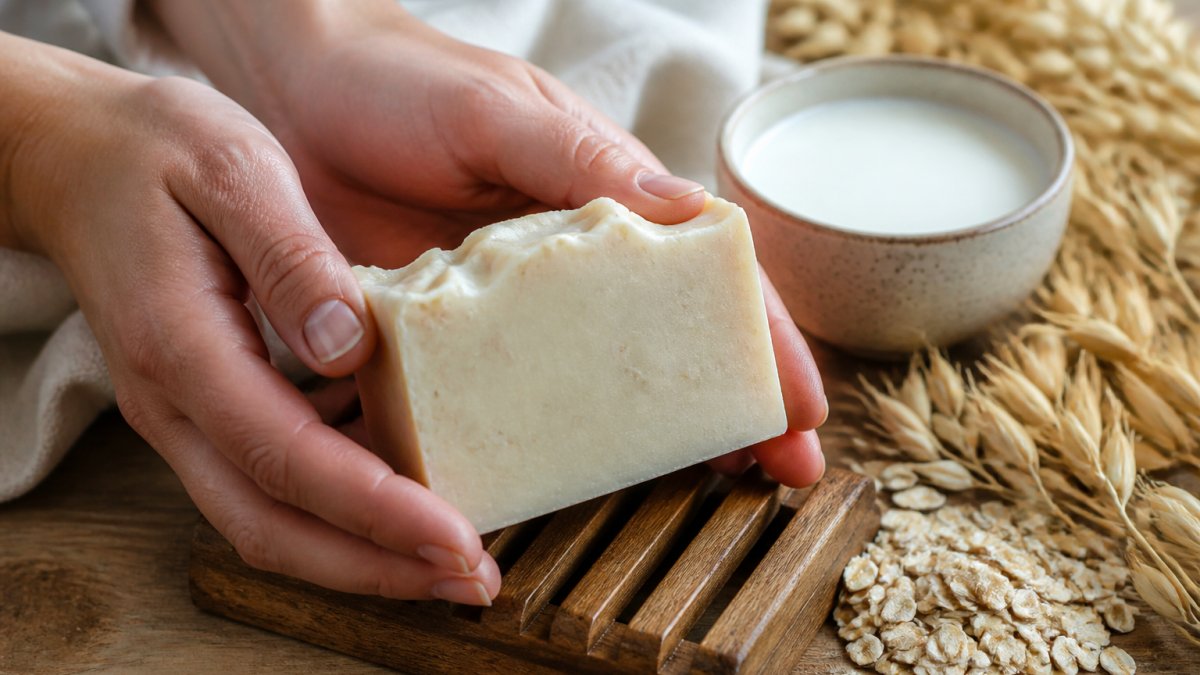
Goat milk soap benefits for skin come down to its natural composition. Goat milk contains lactic acid, a gentle alpha hydroxy acid, plus natural fats and proteins that support moisturizing and soften the feel of rough, dry patches.
Natural Soap for Eczema: What Actually Calms Flare-Ups
Natural soap for eczema works best when it does two jobs: clean gently and support the skin barrier. Colloidal oatmeal, goat milk, and fragrance-free formulas are the ingredients most often recommended for eczema-prone skin.
- Wash with lukewarm water and a mild, soap-free or goat milk bar
- Skip washcloths and loofahs during a flare
- Pat dry, don't rub
- Moisturize within three minutes of washing
How to Treat Sensitive Skin Naturally (Without Triggering a Reaction)
To treat sensitive skin naturally, simplify before you add. Most reactions come from too many products, not too few. A short routine with gentle, fragrance-free cleansing usually calms reactive skin faster than a shelf full of remedies.
Then build a minimal routine:
- Cleanse once or twice daily with a gentle bar
- Moisturize immediately after washing
- Protect with sunscreen during the day
- Introduce one new product at a time, so you know what caused a reaction
Water Hardness: The Factor Most People Ignore
Hard water contains dissolved minerals that can leave a residue on skin and interfere with how well soap rinses away. That residue can feel like dryness or trigger itchiness, even when your soap is gentle.
The Post-Wash Routine That Protects Your Skin Barrier
The first three minutes after washing matter more than most people realize. Skin is most receptive to moisture while it's still damp, so this is your window to lock hydration in.
Here's the sequence:
- Pat dry with a soft towel, leaving skin slightly damp
- Apply moisturizer within three minutes to seal in water
- Layer an occlusive balm over dry patches if needed
- Wait before applying any active ingredients
Cost-Per-Use, Environmental Impact, and Choosing Well
A bar of soap often looks more expensive than a bottle, but cost-per-use tells a different story. Bars are concentrated, contain no water, and typically last weeks of daily showers. Liquid soap is mostly water, so you buy and ship that weight every time.
To run your own cost-per-use math:
- Note the price you paid.
- Estimate washes per unit (a bar lasts most people three to five weeks of daily showering; a bottle lasts a similar span).
- Divide price by washes.
- Compare across formats on that number, not on shelf price.
Here's how the main options compare:
| Option | Best For | Watch Out For |
|---|---|---|
| Goat milk bar | Dry, reactive, eczema-prone skin | Dairy allergies |
| Syndet bar | Very reactive skin, fragrance sensitivity | Can still contain irritants |
| Traditional soap | Normal skin, occasional use | Alkaline, can be drying |
| Liquid cleanser | Convenience, travel | Plastic packaging, water weight |
Conclusion: Finding Your Best Soap for Sensitive Skin
The best soap for sensitive skin is the one that respects your barrier: fragrance-free, pH-balanced, and built on gentle ingredients. If you're tired of reacting to products that promise to be gentle, Deltamoonsoap makes handmade goat milk soap in over 30 varieties, with no parabens or preservatives, plus zero-waste options and complimentary shipping on orders of $40 or more. Shop Deltamoonsoap to find a bar your skin can finally settle into.
Frequently Asked Questions
What is the best soap for sensitive skin?
The best soap for sensitive skin is a fragrance-free, pH-balanced syndet bar or a handmade goat milk soap made without parabens or preservatives. Look for labels that say hypoallergenic, non-comedogenic, and dermatologist-tested. Avoid bars with synthetic detergents, sulfate-free claims that still contain sulfates, and any product listing fragrance or essential oils high on the ingredient list. Always patch test a new bar on your inner forearm for 24 to 48 hours before using it on your face or body.
Are goat milk soaps better for sensitive skin than commercial bars?
Goat milk soap benefits for skin come from its natural fats, lactic acid, and gentle cleansing agents that support the lipid barrier. Commercial bars often use synthetic detergents that strip moisture and disrupt the skin microbiome. Goat milk soap is not automatically better, though. A poorly made goat milk bar with added fragrance oils can still trigger irritation. Choose a goat milk soap that is fragrance-free, preservative-free, and made in small batches so you can verify the ingredient list.
What do dermatologists recommend for very sensitive skin?
Dermatologists typically recommend fragrance-free, soap-free cleansers with a pH close to 5.5. They suggest avoiding sulfates, parabens, and synthetic detergents that damage the lipid barrier. For eczema-prone or dermatitis-prone skin, look for products labeled hypoallergenic and dermatologist-tested. A patch test on a small area is always advised before full use. If your skin does not improve after switching to a gentle cleanser, see a dermatologist for a proper diagnosis.
How do I treat sensitive skin naturally without causing irritation?
To treat sensitive skin naturally, start by switching to a fragrance-free, pH-balanced soap or syndet bar. Wash with lukewarm water, not hot, and limit showers to 10 minutes. Pat dry and apply a moisturizing emollient within three minutes while skin is still damp. Add a humectant like glycerin or hyaluronic acid before the emollient if your skin feels tight. Avoid wool clothing, harsh laundry detergents, and sudden temperature changes. Patch test every new product, even natural ones, because botanical ingredients can still cause contact dermatitis.